Showing posts with label SDP001 Research. Show all posts

Thursday, 21 April 2011

Fabric Sourcing

I went around London looking for potential fabrics that could be used for both design one and design two. I found a lot of different varieties and colours for the top fabric for design two. I chose some black, red and gold/brown silks for potential fabrics for the jacket and the skirt. The choice would then be left to the designer as to which he prefers. 

I also found lots of different samples for the black muslin that could be used for the blouse and the black velvet that would be used for the lapels and cuffs. I decided to by some of this to use within my toile to create the look with different weights of fabric. 

However, I had great trouble looking for a silk and cashmere blend fabric. Every shop I went into looked at me like i was mad! I did find some samples of different potential fabrics that could be similar to the colour description but does not have the fibre content required. 

I wrote to the museum where design ones original dress is but unfortunately they refused to give me any images of the garment. This did not help me with looking for fabrics.

I did however find some great samples for cottons both plain and glazed for the lining of design one as well as some gorgeous lace that could be added to the chemise underneath the dress. 

Please see my work book for all the samples found in London.

Wednesday, 20 April 2011

Maidstone Museum and Bentlif Art Gallery

While away on Easter break I visited the Maidstone Museum and Bentlif Art Gallery to  look though there costume collection. 

I really enjoyed this visit but however did not learn much as the notes with the costumes were not very detailed and there was no-one in charge of the costume around that day to talk to. But however it was very interesting seeing some more different garments from all periods of the 19th Century.

Please see below for images taken at the museum:


I was interested by this wedding dress as it is very similar to  the ideas that I had for the back of my second design and it was really nice to see this in 3D rather than 2D in a book.


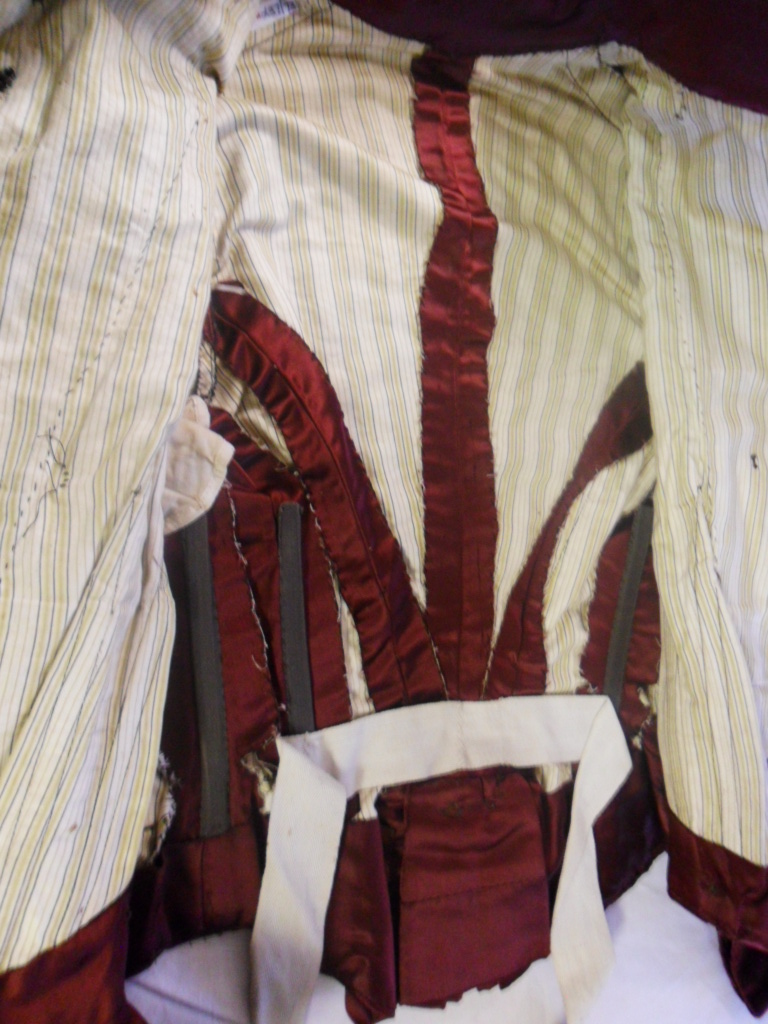
I was interested by this image of a mock up corset. I was aware that makes often created small samples of there dresses so that the customer might know what they are buying but I did not realise that they also did this for corsets.

Friday, 1 April 2011

Useful and Developed Research: Design Two

After choosing my design I went back to the library at various points while draping to find research to help me with decisions on what roots to take.

There is a larger amount of research in my work book which I found very useful while draping the pattern. However below are a few images that really helped me:

 Waugh, N. (1996). 
 Lynn, E. (2010). 

Looking at images of different corsets within the 1890's is a great way to learn and think about different underwear that would be needed underneath my garment.
 Blum, S. (1974). 

I found this image useful as it is similar to the design. The skirt and sleeves are very similar but in a lot more detail in this drawing.
 Hunnisett, J. (1988) 

Images and patterns such as this helped me work out a pattern for my skirt.
 Blum, S. (1974).
 Bradfield, N. (2009). 

I loved the simplicity in the curved and slimming lines of this garment and decided that it is a silhouette that I want to portray in my own garment.
 Waugh, N. (1994). 

Patterns such as this helped me look at creating the blouse. 
 Waugh, N. (1994).
 Taschen. (2002). 

I used this image as a main inspiration when draping the back of my jacket.
Taschen. (2002).
 Taschen. (2002). 
  Waugh, N. (1994).

This images really helped me with creating the pattern for my blouse and my pattern is heavily based on this pattern.

Wednesday, 30 March 2011

Time Line

This is the time line that I have drawn based on my research:


I have found this really useful for learning all the different silhuettes and changes thoughout the 19th Century. I am very keen in my own time to create a time line of the other Centurys for my own personal use to firstly learn all the Centurys in more detail and to have a piece of very useful document that can allow me to cross referance a dress to calculate a possible date down to the last 5 years.

Saturday, 12 March 2011

AUCB Costume Store

Emily, Jen and I went to the AUCB Costume Store to look at all the undergarments that are available for us to use. We felt that this would be important as there would be no point in deciding on a design to recreate if there was no under structure to support the design.

Looking though these undergarments might help me decide what designs will be the best ones to choose.

Here are some images of the different styles of 19th Century underwear we could find. 


There are a few different size corsets but unfortunatly they are all a quite modern cut. I think that this will not be a problem though because as long as the best fitted corset it found then the garment should drape very well as the corset will still take the woman in at the waist and hips.


There are also bum pads, hip buckets, and frills available and a few more petticoats if needed to padd the mannique slightly more. 

Unfortunatly in terms of understructor  of the skirt there is a very limited suply but looking though them all has helped me to decide on a deisgn that will work with the items i have.

Friday, 11 March 2011

Hampshire County Museum Services Costume Collection in Winchester

Again the 19th Century Cutting on the Stand project have been very privaliged to be able to go to the Hampshire County Museum Services Costume Collection in Winchester. The Curator had taken out various items for us to look though including dresses from mid to late 19th century, corsets, crins and bodices.The Curator also went off to get us different books to look though which she recomended. The Curator was very helpful and answered all our questions with alot of care for the subject.

I learnt about all the different types of corsets and bodices. And learnt about various interesting facts. For example while looking though the MODiP we found that a bodice had a cut in the button stand. We were unsure if maybe this was because the garment had been riped. I asked the Curator about this when a bodice came out that also had this small cut at the front of the button stand. She said that the reason behind this small cut is for a pocket watch on a chain.


Please see below for a selection of images from my visit.
This early 1830's corset was really interesting because i did not think that they looked this simple.


Looking at different crinolines was really interesting to see how different types can create such different silhouettes.


This was really interesting becuase the dress is so well and carfully made by both hand and machine stitches but the buttons have been sewn on so badly.


I learnt so much from this showing of the collection and found it really interesting not just for my studies but in my fascination of history and costumes.